Summary:
• A corporate cafeteria POS system centralizes payment processing, inventory tracking, and payroll deduction tenders so employee foodservice operations run with fewer manual steps.
• Core features typically include ID badge scanning, self-service kiosks, kitchen display routing, and online ordering integrated with payroll systems.
• Multi-location reporting and auto menu rotation help facility managers track inventory and demand across sites from a single dashboard.
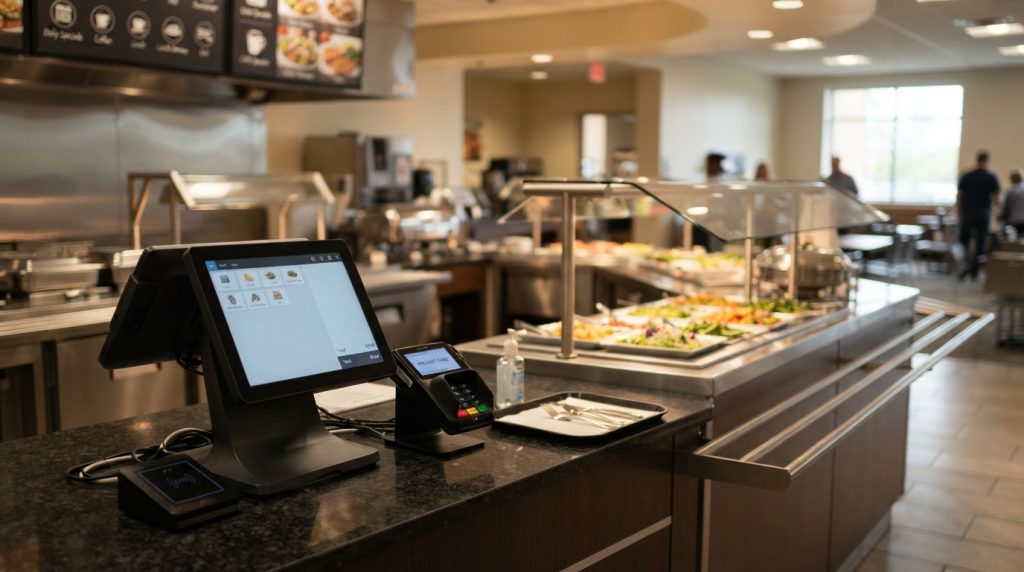
Corporate dining facilities across the USA process hundreds of transactions during narrow lunch windows, which makes checkout speed and payment accuracy a daily operational concern. A Corporate Cafeteria POS system addresses this by combining cashless payment handling, inventory updates, and order routing into one platform rather than relying on separate registers and spreadsheets. The result is shorter lines at peak hours, fewer pricing and counting errors, and clearer sales data for managing menus and food costs. If you’re evaluating options for your cafeteria, Contact ARBA Retail Systems to discuss your volume, payment methods, and integration needs, and to see how a purpose-built system would fit your operation.
Facilities that adopt this type of software are generally trying to solve three recurring problems: slow checkout lines, inconsistent inventory counts, and the administrative burden of tracking employee meal subsidies manually. The right system is built to reduce friction at each of those points.
Core Functions That Reduce Manual Work
Cafeteria POS platforms built for corporate environments tend to share several functional building blocks rather than a single feature. Common components include ID badge scanning or cafeteria card systems, online ordering, self-service kiosks, payroll deductions, kitchen display systems, and digital signage.
• ID badge or card-based payroll deduction tenders, which let employees pay for meals through automatic wage deductions instead of cash.
• Self-service kiosks configurable for self-ordering or full self-checkout.
• Kitchen display routing, which sends orders directly to prep stations instead of relying on printed tickets.
• Online and mobile ordering tied to the same account balances and transaction history used at the register.
ARBA’s self-ordering software comes in the form of highly configurable self-service kiosks and online ordering solutions that can be configured for either self-ordering or full-self checkout, and can print barcodes for grab-n-go items or send orders to kitchen stations for fulfillment. That kind of order routing cuts down on the back-and-forth between front counter staff and kitchen teams during peak service.
Payroll Deduction and Cashless Payment Handling
Payroll deduction tendering is one of the more distinctive capabilities tied to corporate cafeteria operations, separating it from standard retail point-of-sale setups. Cashless payment types like payroll deductions and credit cards let employees scan their ID badges to perform payroll deduction tenders, a benefit woven into their daily routine.
This matters operationally because manual meal-charge tracking is error-prone and time-consuming for finance teams. POS solutions designed for this use case can be configured to manage employer-paid meals, meal allowances, and subsidized food programs for staff in corporate cafeterias and other institutional settings. Facilities that have implemented payroll deduction tendering have reported measurable effects on sales; one food services client noted that payroll deductions increased cafeteria sales by 25 percent after go-live, according to a testimonial published on the ARBA Retail Systems website.
Cashless adoption in foodservice broadly is not an isolated trend. Industry data compiled from National Restaurant Association research shows that cash now accounts for only a small share of restaurant transactions nationwide, with digital and contactless payments representing the clear majority of dining transactions as of recent reporting. Corporate cafeterias are following a similar pattern as facility managers look to reduce cash handling and reconciliation work.
Inventory, Menu Rotation, and Multi-Location Reporting
Beyond the register, a cafeteria POS system typically manages stock levels and menu logistics behind the scenes. A cafeteria POS automatically updates stock levels of ingredients as meals are sold, reminds of low stock, and accommodates menu rotation depending on sales data, while allowing configuration of prices, building combos, and predicting demand.
For organizations running more than one cafeteria or company store, centralized reporting removes the need to reconcile data site by site. Enterprise solutions can include centralized reporting accessed from one location and inventory control managed over multiple locations from a single database. That structure gives facility directors a consolidated view of sales and stock trends without pulling reports manually from each site.
Frequently Asked Questions
1. Does a corporate cafeteria POS handle online and mobile ordering?
→ Cafeteria point of sale solutions can include a cash register system that fully supports online ordering, allowing employees and customers to place orders in advance via a web portal or mobile app, with fulfillment types including pick-up, delivery, patient room delivery, and inter-office delivery.
2. Can the system integrate with existing payroll software?
→ ARBA’s platform lists integrations with payroll providers, which allows deduction amounts to sync with payroll cycles already in use at a company rather than requiring a separate manual reconciliation step.
3. What hardware typically works with a cafeteria POS?
→ A reliable interface with barcode scanners, receipt printers, and payment processors is essential to day-to-day operation. These components connect to the core software to handle scanning, printing, and card or badge-based payments at the counter.
A Note on Reviewing Options
Facility managers evaluating a new system for an employee dining program typically compare feature sets, hosting options, and payroll integration before making a decision. For business location and contact details, view ARBA Retail Systems on Google Maps.