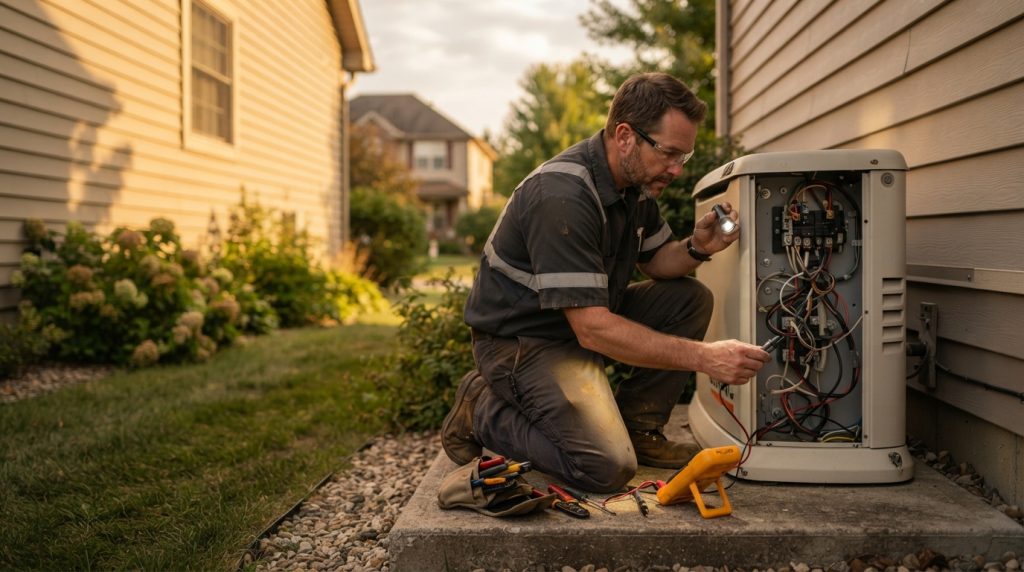
Snapshot:
- A home emergency generator restores power automatically within seconds of a utility outage using a transfer switch that senses the loss and starts the unit.
- Sizing depends on actual electrical load (square footage, HVAC, appliances), not home size alone.
- Installation and permitting for standby systems in Madison, MS fall under Mississippi electrical code and require a licensed electrician.
A home emergency generator is a permanently installed backup power system that detects a utility outage and restores electricity to a house automatically, usually within seconds. Unlike a portable unit that requires manual setup, a standby system runs on natural gas or propane and connects directly to the home’s electrical panel.
Homeowners researching a Home Emergency Generator typically want to know how the equipment functions, what size unit a house needs, and what installation involves before committing to the investment. The answer depends on load calculations, fuel type, and local code requirements rather than guesswork based on square footage alone.
How a Standby Generator Works
A standby generator sits outside the home, similar to a central air conditioning unit, and stays connected to the household electrical system at all times. When utility power fails, a dedicated device recognizes the interruption and starts the engine without any action from the homeowner.
- An automatic transfer switch senses the power loss, commands the generator to start and then transfers the electrical load to the generator.
- The standby generator begins supplying power to the circuits.
- After utility power returns, the automatic transfer switch transfers the electrical load back to the utility and signals the standby generator to shut off, returning it to standby mode.
- To ensure a proper response to an outage, a standby generator runs weekly self-tests.
This automated sequence is what separates a standby system from a portable generator, which must be rolled out, fueled, and plugged in manually during an outage.
Sizing a Home Generator Correctly
Choosing the right output is the most technical part of the process, and it depends on the specific circuits a household wants to keep running during an outage. Sizing involves inventorying every electrical load expected to operate during an outage, tabulating steady-state running watts, adding the single largest motor-starting surge, applying standardized demand diversity factors, and adding an operating buffer.
Sizing calculations for permanent systems follow a recognized code framework. For permanent whole-home standby installations, the National Electrical Code provides strict frameworks under NEC Article 220, with sizing following either the Standard Calculation under NEC 220.87 or the Optional Calculation under NEC 220.82 or 220.83. The National Fire Protection Association’s NEC resources outline these standby and emergency power provisions in detail.
| Home Profile | Typical Load Coverage | Common Generator Size |
|---|---|---|
| Small home, essentials only | Fridge, furnace fan, lighting, sump pump | 10-14 kW air-cooled |
| Average home, one central AC | Managed whole-home with load shedding | 18-22 kW air-cooled |
| Larger home, multiple AC units | True whole-home, no shedding | 24-26 kW air-cooled |
A licensed electrician confirms the exact calculation for a specific house rather than relying on square footage estimates alone, since appliance mix and panel amperage change the result significantly.
Installation, Permitting, and Local Considerations in Madison, MS
Mississippi’s storm season, including seasonal thunderstorms and occasional ice events, makes outages a recurring concern for homeowners in Madison, MS. Standby generator installation involves a dedicated concrete or composite pad, gas or propane line connection, and a transfer switch wired into the home’s main panel.
- Permits are typically required for electrical panel work and new standby equipment tied into a residential service.
- A transfer switch must be rated to match or exceed the home’s main panel amperage.
- Annual maintenance, including battery checks and self-test monitoring, keeps the system ready for the next outage.
Based in Canton, MS, where it has operated as a family and locally owned electrical contractor, the company extends its generator installation and maintenance work to surrounding communities, including homeowners in Madison, MS. Electrical permitting and code compliance for this type of work in the region falls under county inspection requirements tied to the Mississippi Residential Code.
Frequently Asked Questions
How long does a home emergency generator run during an outage? Most natural gas or propane standby units can run continuously as long as fuel supply is maintained, since they are not limited by a fuel tank the way portable gasoline generators are.
Does a standby generator power the entire house? It depends on the unit’s output and the home’s load. Some systems are sized for whole-house coverage, while others are designed to run only essential circuits, such as HVAC, refrigeration, and lighting.
How often does a standby generator need maintenance? Routine checks, typically on an annual basis, cover the battery, oil, air filter, and the weekly self-test cycle that confirms the transfer switch and engine are functioning correctly.
Is a permit required to install a home standby generator? In most Mississippi jurisdictions, yes. Electrical panel connections and new standby equipment generally require a permit and inspection to confirm compliance with local code.
Business Info
Rinewalt Electric LLC is an electrical contractor based in Canton, MS, offering generator installation and maintenance services as part of its broader residential and commercial electrical work.
Published details for Rinewalt Electric outline service area coverage for standby generator installation and maintenance.