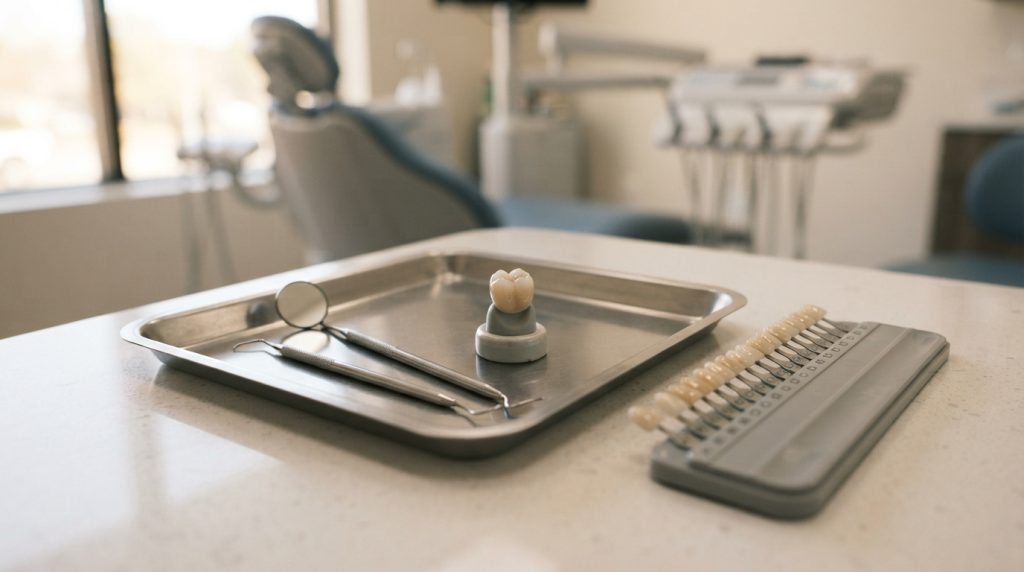
A dental crown is a tooth-shaped covering cemented over an existing tooth or implant to restore its size, shape, strength, and appearance after damage or significant decay. Crowns are typically recommended when a tooth has too little structure left for a filling to hold, or when a tooth needs added protection after a root canal.
Understanding Dental Crowns starts with knowing what they actually repair. A crown entirely covers a tooth rather than filling a small section, which is what separates it from a standard filling. Dentists in the Charlotte, NC area commonly use crowns as part of broader restorative treatment plans when a tooth’s natural structure can no longer support normal biting force on its own.
What a Dental Crown Actually Does
A crown functions as a protective cap rather than a cosmetic add-on, though it can improve how a tooth looks as a secondary benefit. According to the American Dental Association, a crown, sometimes called a cap, is a tooth-shaped restoration that fits over an existing tooth or an artificial tooth root, called an implant.
Crowns are generally placed for specific structural reasons rather than aesthetic preference alone. Based on information published for patients, crowns may be used to:
- Replace a large filling when minimal tooth structure remains
- Protect a weak tooth from potential fracturing
- Restore a fractured tooth to its original form and function
- Serve as an attachment point for a dental bridge
- Cover a dental implant for a natural look and feel
- Conceal a discolored or poorly shaped tooth for improved aesthetics
- Cover a tooth that has undergone root canal treatment for added protection
Each of these situations reflects a tooth that needs more support than a filling or bonding material can provide on its own.
Signs You May Need a Crown
Several warning signs suggest a tooth may require a crown rather than a smaller restoration. A tooth that has a visible crack extending toward the gumline, persistent sensitivity after a large filling, or significant wear from grinding often falls into this category. Guidance published for dental patients notes that a crown becomes the indicated restoration when a tooth is too damaged or weakened for a filling to hold, which is a key clinical threshold dentists use when evaluating treatment options.
A dentist typically confirms the need for a crown through an exam and X-rays rather than through symptoms alone, since internal cracks and decay are not always visible without imaging.
Crowns Compared to Other Restorative Options
Choosing between a crown, a filling, or a bridge depends on how much natural tooth structure remains and whether a tooth is missing entirely.
This comparison shows why crowns sit between smaller fillings and full tooth-replacement options like bridges or implants.
|
Restoration |
Best Used For |
Structural Coverage |
|
Filling |
Small to moderate cavities |
Fills a limited area of the tooth |
|
Crown |
Teeth with major damage, fractures, or post-root-canal protection |
Covers the entire visible tooth |
|
Bridge |
Replacing one or more missing teeth |
Uses crowns on adjacent teeth for anchoring |
|
Implant crown |
Replacing a single missing tooth root and crown |
Caps an implant post below the gumline |
How Crowns Connect to Bridges and Implants
Crowns rarely function in isolation; they are often part of a larger restorative plan. A dental bridge, for instance, relies on crowns placed over the teeth on either side of a gap to anchor the replacement tooth in between. Crowns also cap implant posts, giving a restored tooth a natural appearance while distributing bite force evenly across the jaw.
Materials selected for a crown, such as porcelain, zirconia, or metal alloys, affect both durability and appearance, and a dentist typically weighs these factors against the location of the tooth and the patient’s bite pattern.
Frequently Asked Questions
How long does a dental crown procedure take? Most crown procedures require two visits: one to prepare the tooth and take impressions, and a second to fit the permanent crown once it has been fabricated.
Does getting a crown hurt? The tooth is typically numbed before reshaping, so the procedure itself is not usually painful, though some sensitivity can occur for a few days afterward.
Can a crown fail or need replacement? Crowns can eventually need replacement due to wear, decay at the margin, or damage to the underlying tooth, which is why regular dental checkups matter.
Is a crown the same as a cap? Yes, “cap” is simply another common term for a dental crown, referring to the same full-coverage restoration.
Business Info
Caldwell, Bills, Petrilli & West Dentistry is a dental practice serving patients in Charlotte, NC that provides restorative treatments including crowns and bridges. Additional details about the practice’s crown and bridge services are published on its Caldwell, Bills, Petrilli & West Dentistry profile.
Learn More About Restorative Dental Care
Published details for Caldwell, Bills, Petrilli & West Dentistry describe crown and bridge treatment options available to patients in the local area.