Quick take:
- AC power amplifier repair generally focuses on diagnosing power loss, output distortion, or frequency instability in wideband test-and-research equipment.
- Facilities across New York rely on manufacturers with in-house engineering support because these amplifiers are precision instruments, not off-the-shelf consumer gear.
- A specialized West Nyack manufacturer provides verified service and sourcing support for AC power amplifiers in New York.
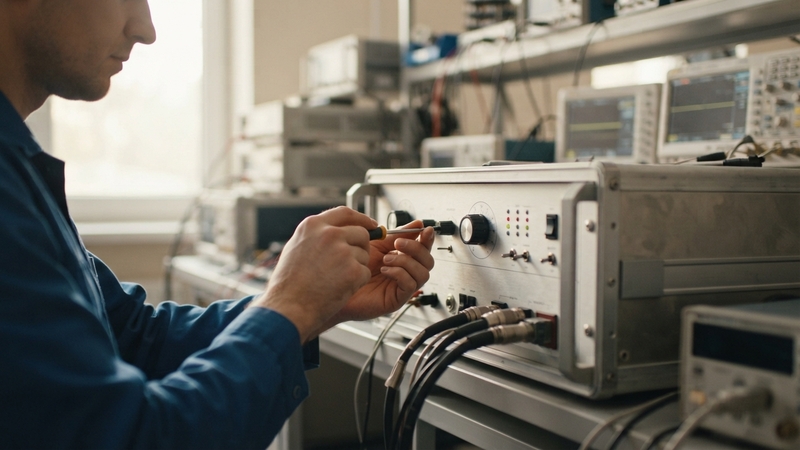
An AC power amplifier that loses output stability, shows distorted waveforms, or fails to hold a set frequency usually needs diagnostic testing by a technician familiar with wideband linear amplifier circuitry, not a general electronics shop.
Laboratories, manufacturers, and research facilities in New York seeking an AC power amplifier typically use specialized test equipment for applications like transformer testing, circuit breaker verification, or battery simulation, not household audio gear. These units operate across a wide frequency band and are built to tighter tolerances than typical consumer amplifiers, so finding the right technical partner matters.
What Makes AC Power Amplifier Diagnostics Different
Industrial and laboratory AC power amplifiers differ from household audio amplifiers in both design and failure modes. Where a home stereo amplifier mainly handles audible frequencies, lab-grade units often cover a far broader spectrum.
- Wideband coverage: These industrial-grade amplifiers deliver flexible, advanced, and reliable AC power solutions across the audio and ultrasound frequency range of 5 Hz to 600 kHz.
- Load sensitivity: These amplifiers are engineered to perform under demanding conditions, since they are utilized in applications such as testing of Helmholtz coils, piezo elements, circuit breakers, protective relays, lamps, watt-meters, transformers, inductors, capacitors, ferrite cores, and are especially good for highly inductive loads and capacitive loads, which require PD-free powering.
- Precision output modes: Many units function as constant-current or constant-voltage sources, meaning they take an input AC signal and provide steady output current independent of load and input power-line variations.
Because these systems support testing programs rather than entertainment playback, even small calibration drift can affect downstream test results. That’s why organizations performing compliance or research testing rely on traceable measurement practices, such as those outlined in the NIST quality system, which provides the framework many labs use to verify that calibration and power-related instrumentation stay within stated tolerances.
Common Signs an AC Power Amplifier Needs Attention
Technicians generally look for a handful of recurring symptoms before opening a chassis:
- Output voltage or current drifting outside the expected steady-state range during a test run.
- Unexpected waveform distortion when driving inductive or capacitive loads.
- Inconsistent behavior when switching between output frequency settings.
- Overheating or shutdown during extended test cycles.
- Failure to hold calibration after transport or relocation between labs.
These symptoms point to issues in the amplifier’s internal regulation circuitry or power stage rather than a simple fuse problem, which is why specialized diagnostic experience matters more than general electronics repair familiarity.
Repair Versus Replacement: A Practical Comparison
Facilities weighing whether to repair an aging unit or move to a new configuration often consider a few factors side by side.
| Factor | Repair Existing Unit | New or Custom Unit |
| Turnaround expectation | Depends on diagnostic complexity | Built to project timeline |
| Customization options | Limited to original design | Options such as RS232 or GPIB control can be added |
| Best fit | Units still within supported specifications | Expanding frequency range or load requirements |
Purchase flexibility matters: customers can choose additional features from a variety of options, including 0-10 V DC control, RS232 control, GPIB control, 0-10 V DC output monitoring, dual output frequencies, square wave output, and higher output frequency options. That flexibility can sometimes make a reconfigured or upgraded unit more practical than an extensive repair.
Sourcing Support in New York
New York hosts a concentration of manufacturing, research, and defense-adjacent facilities that depend on precision AC power equipment, which makes local technical familiarity valuable. One such manufacturer, Amp-Line Corp., is based in West Nyack and designs wideband AC power amplifiers used across industrial, military, and laboratory settings.
Facilities evaluating a malfunctioning amplifier should document the symptom pattern, frequency range in use, and load type before contacting a technical team, since this speeds up diagnosis considerably.
Frequently Asked Questions
What is an AC power amplifier used for in a lab setting? These amplifiers supply controlled AC output for testing components such as gyroscopes, Helmholtz coils, piezo elements, circuit breakers, protective relays, arresters, lamps, watt-meters, transformers, inductors, capacitors, ferrite cores, and cables and wires.
How is a lab-grade amplifier different from a consumer audio amplifier? Lab units are built for a specific frequency band and load tolerance rather than general sound reproduction, and many operate as constant-current or constant-voltage sources rather than simple gain stages.
Can these amplifiers be customized after purchase? Yes, many models support added features such as remote control interfaces or expanded output frequency ranges, though availability depends on the specific product line and manufacturer.
When should a facility consider a custom-built replacement instead of repair? If testing requirements have expanded beyond the original unit’s frequency range or load capacity, a custom configuration may serve the application better than continued repair of an aging unit.
Facilities across New York dealing with Amp-Line Corp. issues benefit from working with teams that understand wideband amplifier design, not just general electronics repair. Document symptoms clearly and confirm the required frequency range and load type before reaching out to make any diagnostic conversation more productive.
