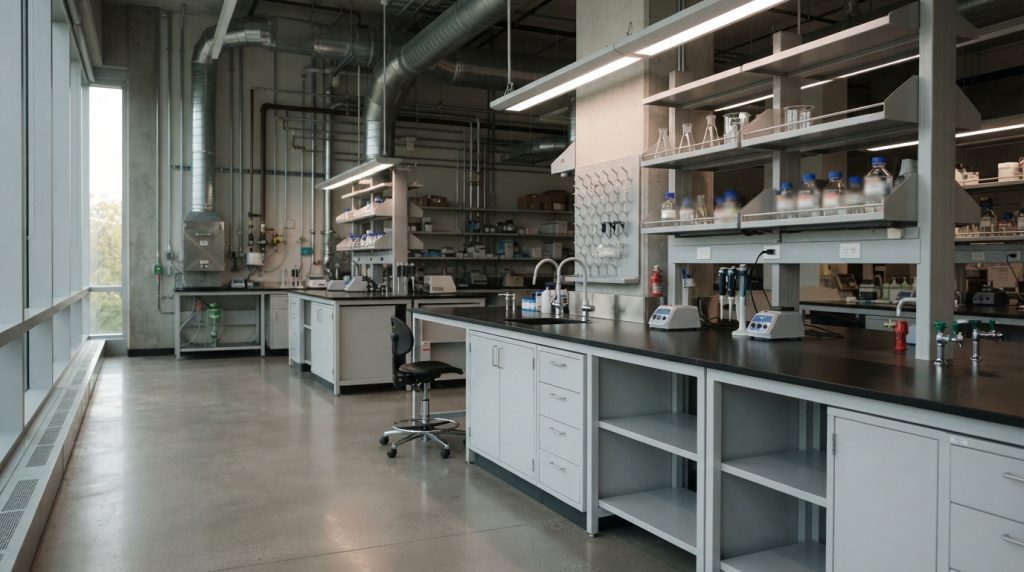
Snapshot:
- Custom lab furniture is built around a facility’s specific workflows, chemical exposure risks, and equipment loads rather than fitted to a generic layout.
- Material choice (steel, wood, laminate, or epoxy resin) determines chemical resistance, cleaning requirements, and long-term durability in a research setting.
- Modular casework and adjustable workstations allow labs to reconfigure space as research needs and safety protocols change.
Research spaces run on precision, and the furniture surrounding a bench often determines whether that precision holds up under daily use. Custom lab furniture is engineered to match a facility’s specific hazards, equipment footprint, and traffic patterns, rather than forcing researchers to adapt to standardized cabinetry. When casework, fume hood placement, and storage are planned around actual workflow, the result is fewer bottlenecks and fewer points where contamination or injury can occur.
Fit-for-purpose casework matters because laboratories across the Custom Lab Furniture differ enormously in what they handle day to day. A forensic lab processing evidence has different storage and surface requirements than a pharmaceutical quality-control bench or a university teaching lab. Furniture sized and configured for the actual work reduces the awkward reaches, cluttered surfaces, and improvised storage that tend to precede spills or dropped samples.
Why Workflow Depends on Furniture Layout
Bench height, aisle width, and the placement of sinks or gas outlets all affect how quickly and safely a researcher can move through a protocol. Poorly planned layouts force staff to carry hazardous materials across longer distances or work in cramped postures that increase fatigue-related errors.
Design guidance from research universities reinforces this link between layout and safety. The University of New Mexico’s laboratory design standards specify that spaces between benches, cabinets, and equipment must remain accessible for cleaning, and that furniture must support anticipated uses and loads. That kind of clearance planning is difficult to retrofit into off-the-shelf furniture but can be built in from the start with custom layouts.
Common workflow improvements tied to furniture design include:
- Adjustable-height benches that accommodate seated and standing tasks without repositioning equipment
- Mobile workstations that let a lab reconfigure bench arrangements between experiments
- Dedicated storage zoned by chemical compatibility to reduce cross-contamination risk
- Clear sightlines and walkways that keep emergency equipment reachable within seconds
Material Selection and Chemical Resistance
The material a bench or cabinet is built from affects how well it holds up against solvents, acids, and repeated decontamination cycles. Steel, wood, laminate, and epoxy resin each perform differently depending on the chemicals and loads a lab expects to handle.
| Material | Chemical Resistance | Typical Use Case |
|---|---|---|
| Epoxy resin countertops | High resistance to acids, solvents, and heat | Chemistry and research benches |
| Stainless steel | Strong corrosion resistance, easy to sanitize | Biosafety and cleanroom environments |
| Wood casework | Moderate durability, lower chemical tolerance | General-purpose labs, classrooms |
| Laminate | Cost-efficient, moderate resistance | Teaching labs, low-hazard workspaces |
Federal workplace safety guidance under OSHA’s laboratory standard addresses the broader obligation to control chemical exposure in these environments, which is one reason material selection for benchtops and storage is treated as a safety decision rather than a purely aesthetic one.
Planning for Flexibility and Compliance
Laboratories rarely stay static. Equipment changes, staff headcounts shift, and research priorities move in new directions, so furniture that can be reconfigured without full replacement protects both budget and continuity. Modular casework systems, slotted-post benches, and movable workstations are designed with this kind of change in mind.
Compliance adds another layer to furniture planning. Industry seating and casework standards published through the Scientific Equipment and Furniture Association guide how chairs, benches, and cabinets are tested for chemical resistance, structural load, and safe use in laboratory settings. Facilities across the United States increasingly specify furniture that meets these benchmarks before construction begins, since retrofitting non-compliant casework later is costly and disruptive.
Kewaunee Scientific, a laboratory furniture manufacturer, is one example of a company in this sector; general information about the business is available through its Kewaunee Scientific Google Business Profile listing. Mentioning a single manufacturer here is incidental to the broader point: furniture decisions in any research facility should be driven by documented hazards, workflow data, and recognized industry standards rather than by convenience or cost alone.
Frequently Asked Questions
What makes lab furniture “custom” rather than standard? Custom furniture is sized, configured, and finished to match a specific facility’s bench heights, equipment loads, chemical exposure, and traffic flow, instead of using fixed stock dimensions.
Does custom furniture cost more than standard casework? Upfront costs can be higher due to design and fabrication time, but better-matched materials and layouts often reduce retrofit and replacement costs over the life of the lab.
How does furniture choice affect lab safety compliance? Material and construction choices determine whether furniture meets chemical resistance, load-bearing, and cleanability requirements referenced in laboratory design standards used across the United States.
Can existing labs be retrofitted with custom furniture? Yes, modular and mobile furniture systems are commonly used to upgrade existing labs without a full facility rebuild, provided utility connections and structural loads are assessed first.
Furniture decisions shape how safely and efficiently a laboratory operates every day, from bench height to chemical storage. Facilities planning a renovation or new build can review current design standards and consult qualified lab planners before finalizing layouts.