• Laser welding uses a concentrated beam of light to fuse metal components with minimal heat input and tight tolerances.
• Industrial and medical manufacturers rely on the process for small, intricate, or heat-sensitive parts that cannot tolerate distortion.
• Material choice, part geometry, and production volume determine whether manual or programmable laser welding is the better fit.
Precision laser welding joins metal parts by directing a focused beam of light energy onto a targeted area, creating a controlled weld with minimal surrounding heat damage. This makes it suited to components where distortion, warping, or excess heat could ruin a finished part.
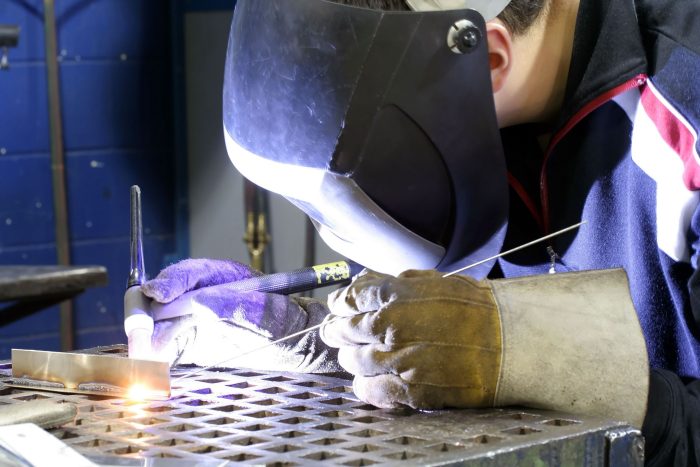
Manufacturers searching for Laser Welding Solutions are typically dealing with small or intricate components, such as medical devices, mold tooling, or machined parts, that require tight dimensional control. Microscopic laser welding uses a concentrated heat source, allowing for precise, controlled weld placement. That precision is what separates laser welding from broader fabrication methods like MIG or stick welding, which deposit more heat and filler material over a wider area.
How Precision Laser Welding Works
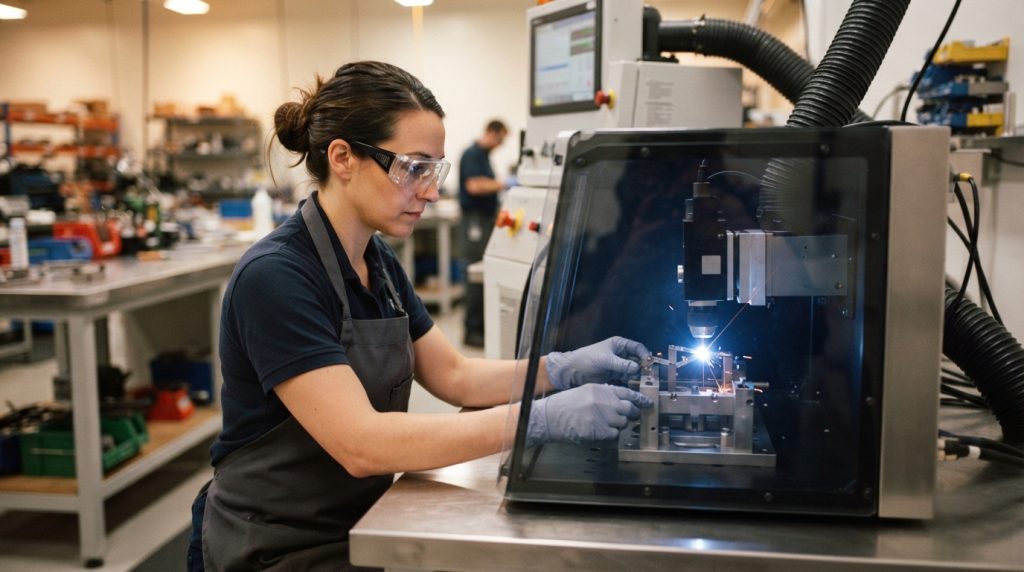
Laser welding directs a narrow, high-intensity beam at the joint line, melting the base metals so they fuse without the need for extensive filler. An enclosed machine directs light energy to metal in order to fuse the pieces together. Several factors shape how a weld forms:
• Beam focus and power determine weld depth and width at the joint.
• Material composition affects how much laser energy the surface absorbs, which influences weld consistency.
• Travel speed controls how quickly the laser moves along the seam, balancing penetration against heat buildup.
According to NIST research on laser-metal interaction, the fraction of laser light absorbed by a workpiece changes rapidly during the first milliseconds of exposure, depending on surface finish, laser intensity, and the presence of a vapor cavity. That variability is one reason experienced operators adjust parameters by material type rather than applying a single setting across every job.
Manual Versus Programmable Laser Welding
Industrial laser welding generally falls into two operational categories, each suited to different production needs. Manual and CNC programmable laser beam welding services are both available, with manual micro laser welding requiring precise, careful craftsmanship to join or repair parts.
|
Factor |
Manual Laser Welding |
CNC Programmable Laser Welding |
|
Best for |
One-off repairs, prototypes |
Repeatable production runs |
|
Operator involvement |
High, skill-dependent |
Lower, program-driven |
|
Consistency |
Varies by technician |
Highly repeatable |
|
Typical use case |
Mold revisions, R&D parts |
Higher-volume medical or industrial components |
Choosing between the two depends on part volume, tolerance requirements, and whether a design is still in development or already finalized for production.
Materials and Industries That Rely on Laser Welding
Laser welding accommodates a range of metals commonly specified in industrial and medical manufacturing. Materials that can be micro welded include stainless steel, aluminum, carbon steel, copper, titanium, platinum, and nitinol. These materials appear across several industries:
• Medical device manufacturing, where small, heat-sensitive components require welds that preserve surrounding material integrity.
• Mold and tooling work, including revisions and repairs to production molds.
• General industrial and machined component manufacturing across the USA.
Micro welding can reach hard-to-access areas and delivers precise, small welds in vital areas that must be preserved from distortion and heat sink. This matters most on parts where even slight warping affects fit or function, such as surgical instruments or precision-machined assemblies.
Frequently Asked Questions
Is laser welding better than TIG welding for small parts? Laser welding typically produces a narrower heat-affected zone, which benefits small or delicate components, while TIG welding remains a common choice for parts that can tolerate broader heat input or require filler material buildup.
What industries use precision laser welding most often? Medical device manufacturing, mold and tooling repair, and general industrial component production are among the most common applications, particularly where tight tolerances and minimal distortion are required.
Does laser welding work on all metals? No single process suits every metal equally; weldability depends on how a material absorbs and conducts laser energy, which is why parameters are adjusted for each material type rather than standardized across all jobs.
Is laser welding more expensive than traditional methods? Equipment and setup costs for laser welding can exceed those of conventional arc welding, though the trade-off is often justified by reduced rework and tighter dimensional accuracy on small or complex parts.
Manufacturers across the USA evaluating precision joining methods for small or heat-sensitive components can use the process comparisons above to determine whether laser welding fits a given part’s tolerances and production volume. Micro Weld, Inc. operates as a precision welding provider, and published information about its location and services is available through Micro Weld, Inc..