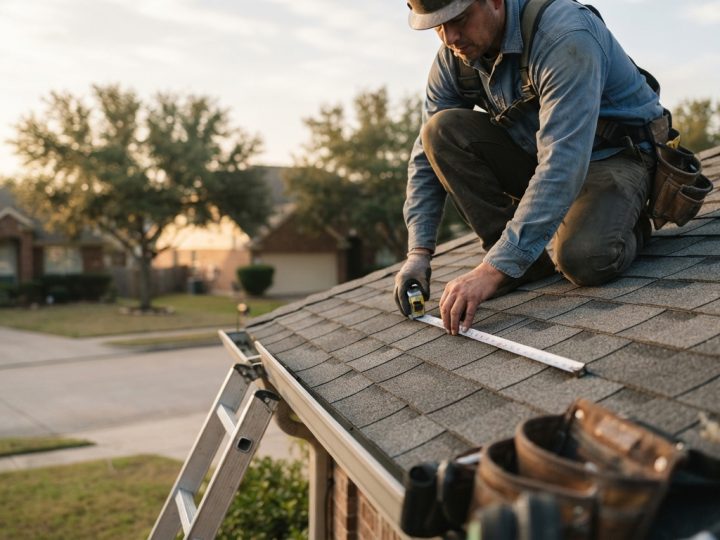
A commercial roof inspection report should state what was inspected and what wasn’t, tie every finding to a mapped roof location with captioned photos, and separate what was observed from what it might mean and what should happen next. Valley Roofing & Repair, a Phoenix roofing company, describes their inspections as pairing photo documentation with a written report of findings and recommendations. That’s a useful baseline for property managers to expect when they ask commercial roofers for a report.
A report often outlives the inspection. It gets forwarded to owners, handed to maintenance staff, and pulled out months later when a leak returns. The test is simple: could someone who never stood on the roof understand what was found, where it is, what remains uncertain, and what decision comes next?
Does the Report Say What Was Inspected and What Wasn’t?
Every report should open by establishing its own scope. Without that, photos and recommendations can be hard to connect to a specific building, roof, or visit. Property managers should look for:
- The property name, address, and building designation on multi-building sites
- The inspection date and, when relevant, the weather at the time
- The name and company of the person who performed the inspection
- A general description of the roof system, where it could be identified
- The reason for the inspection, such as a routine check or a reported leak
- Areas that were inspected and areas that couldn’t be accessed
The reason for the visit shapes the scope. An inspection focused on one reported leak may not cover the whole roof the way a broader condition assessment would. A report that clearly lists inaccessible areas, whether blocked by equipment, locked, or unsafe to reach, is more useful than one that appears complete while leaving coverage questions open.
Can Someone Who Wasn’t on the Roof Find Each Problem?
A report becomes hard to use when its findings lack clear locations. “Damaged flashing near HVAC unit” isn’t much help on a roof with a dozen units.
A roof plan solves most of this. It doesn’t need to be an architectural drawing. A simple layout with roof sections labeled A, B, and C, plus drains, scuppers, access points, and rooftop equipment, gives each finding a home. Numbered markers on the plan can match photo numbers in the report, so a reader can move from the diagram to the image to the written finding without guessing.
Photos work best in pairs: a wide shot that shows where the problem sits relative to edges, drains, or equipment, and a close-up that shows the condition itself. Each significant photo should carry a caption naming the roof section, the component, the condition observed, and the finding it supports. If scale matters, the image should include a reference.
Photos should support the written findings, not replace them. If an image doesn’t clearly show what the text describes, managers can ask for more documentation.
Does the Report Separate Observations From Conclusions?
This is one of the most useful qualities a report can have. Strong reports keep three kinds of information distinct for each finding:
- The observed condition: what the inspector could see or document.
- The possible implication: what that condition may mean for roof performance.
- The recommended action: what should happen next to investigate or address it.
Specific language makes that possible. “Roof needs attention” tells a manager almost nothing. “Visible opening at a membrane seam, Section B, approximately ten feet east of the north drain; further evaluation recommended” gives them something to act on.
The distinction matters most with leaks. An interior ceiling stain may indicate past or ongoing moisture, but the stain alone doesn’t establish where water entered the roof. Water can travel along roofing components before it shows up inside. If the entry point hasn’t been confirmed, the report should say so rather than presenting a suspected source as a diagnosis.
How Should Drainage and Water Findings Be Described?
Drainage deserves its own clearly marked section. It should cover roof drains, scuppers, gutters, visible drainage paths, debris, and any areas where water appears to collect.
Timing affects what an inspector can see. A dry-weather visit may reveal debris, staining, or sediment lines, but it can’t show how water actually moves during rain. In the Phoenix area, a report written outside the summer monsoon season should acknowledge that limitation rather than imply drainage was fully confirmed.
A good report describes what was visible and notes whether outlets appeared obstructed or water was present. It flags conditions that need follow-up after rain, without treating every stain or low spot as proof of a current leak.
Are Flashing, Penetrations, and Rooftop Equipment Covered Separately?
The main roof surface is only part of the picture. Flashing, pipe penetrations, roof edges, transitions, access hatches, and equipment supports can each be in different condition from the surrounding membrane, so they deserve their own observations.
When a concern sits next to an HVAC unit, the report should say whether the issue appears to involve the roofing system, the equipment, or the connection between them, since that affects who gets called. It should also note when equipment blocked a full view of the roof around it.
How Should Repair Priorities Be Explained?
Not every finding needs the same response. A practical report helps managers sort items into four groups: those that need prompt professional attention, those that need further investigation before a fix can be defined, those that belong in routine maintenance, and those that should be monitored and documented again.
Whether the report comes from an in-house facilities team or an outside Commercial Roofing Services provider, priority labels need explanation. “High” or “Priority 1” isn’t a universal technical standard. The report should say what each label means and why it applies to a given finding.
Each recommendation should also connect to its finding. A visibly open seam might call for closer evaluation before a repair method is chosen. Accumulated debris at a drain might call for removal followed by a drainage review. When a report identifies a concern without defining the full repair scope, it should say so plainly. That matters when owners must approve spending or when work has to be scheduled around tenants.
How Does an Inspection Report Differ From a Repair Proposal?
The two documents are related but serve different purposes. The report documents conditions and recommendations. A proposal describes the specific work being offered, including its boundaries and assumptions. Before approving commercial roof repairs, property managers can set the two side by side and ask:
- Which report findings does the proposed work address?
- Which roof areas and components are included?
- Are more diagnostic steps needed before the scope is final?
- What work is excluded?
- Could concealed conditions change the approach?
- What tenant coordination or access will be needed?
- How will completed work be documented?
These questions are especially useful when comparing proposals from different commercial roofing contractors. Two recommendations aren’t equivalent just because they concern the same roof. What matters is whether each proposal addresses the same documented conditions and whether the differences in scope are explained.
How Can Property Managers Share Findings With Owners and Tenants?
Managers often have to translate a technical report for people who will never read it in full. A well-organized report makes that easier.
Owners usually need a short summary: which roof sections are affected, how significant the findings are, and which decisions need their approval. Maintenance staff benefit most from the roof plan and photo references. Tenants generally need to know only whether access, scheduling, or interior protection will be required.
Whatever the audience, uncertainty shouldn’t disappear in the summary. If a leak’s source hasn’t been identified, that gap should carry through to every version of the message.
How Should Inspection Records Be Kept Over Time?
A single report captures one visit. Its value grows when reports are kept and compared. Organizing records by building, roof section, and date makes it easier to spot recurring problems and check whether earlier recommendations were followed.
A simple tracking register can list each concern, the recommended follow-up, the responsible party, its current status, and the supporting documents. Those documents include photos, proposals, approved scopes, and completion records. The register should distinguish work that was recommended from work that was completed. Closing an item on paper isn’t proof that the underlying condition was resolved.
Prior records also help when new commercial roofers evaluate a building. They provide background, though they shouldn’t replace an independent look at current conditions.
What Should Property Managers Check Before Accepting a Report?
A short final review can catch most gaps. Can each inspected area be identified on the roof plan? Does every significant finding have a matching photo? Are inaccessible areas disclosed? Does the report keep observations separate from possible causes? Are the recommendations specific enough to start a conversation about next steps?
If the answer to any of these is no, ask for clarification before authorizing work. A vague instruction to “repair the roof” isn’t a plan.
About Valley Roofing & Repair
Valley Roofing & Repair works with residential and commercial property owners across Phoenix, Glendale, and Peoria from their office on North 27th Avenue in Phoenix. Their commercial roofing services include roof inspections, repairs, maintenance, and replacement on flat, low-slope, metal, and single-ply systems. Property managers can reach their team at (623) 250-7663 or view their Google Business Profile for location details.