Recap:
• Family chiropractic care in Englewood, CO typically spans infants, children, pregnant and postpartum patients, adults, and older adults under one practice.
• Look for providers with documented pediatric and perinatal training, a thorough intake process, and transparent communication about what chiropractic can and cannot address.
• A trustworthy clinic screens for red flags, adjusts techniques by age and condition, and explains the evidence behind treatment recommendations.
Choosing the right provider for family chiropractic in Englewood, CO means finding a clinic equipped to treat multiple generations safely, not just adults with back pain. Families searching for this kind of care are usually balancing different needs at once: a toddler with torticollis, a pregnant mother with hip discomfort, and a grandparent managing stiffness. The safest clinics structure their intake, technique selection, and follow-up around those differences rather than applying a single adjustment style to everyone.
What Family Chiropractic Actually Covers
Family-focused clinics are built to serve people at every life stage rather than a single demographic. Services commonly include:
• Spinal adjustments for adults managing mechanical back or neck pain
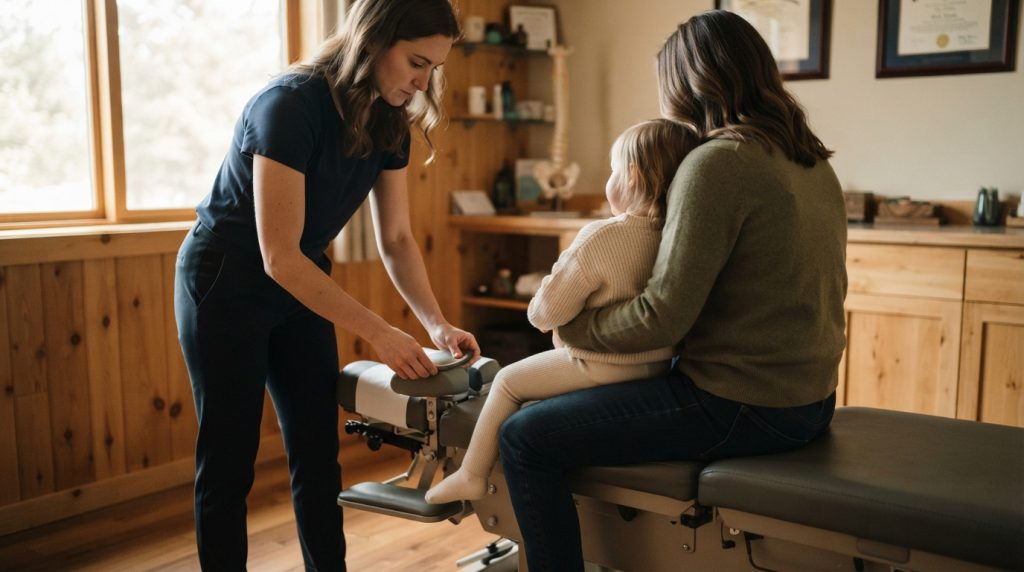
• Pediatric adjustments using lower-force techniques suited to a child’s developing spine
• Perinatal (pregnancy) care addressing pelvic and lower-back discomfort
• Geriatric support focused on mobility and joint comfort
• Soft tissue work to ease muscle tension alongside spinal care
Clinics offering this range typically train providers specifically in perinatal and pediatric populations rather than treating children as smaller adults.
Why Age-Specific Technique Matters
Pediatric chiropractic remains a topic where the research base is still developing, and reputable providers are upfront about that. A 2025 review in Clinical Pediatrics found that chiropractic care has been minimally researched in pediatrics, with multiple systematic reviews concluding there is limited quality and low supporting evidence of effectiveness in children and adolescents. The same review noted that despite this evidence gap, many pediatric patients visit chiropractors, and chiropractors often care for pediatric patients, making discussion of complementary therapies with other providers important for optimal, safety-focused guidance.
This is why credentialing matters more than marketing language. A 2024 Delphi consensus process published in the National Library of Medicine established best-practice recommendations for pediatric chiropractic management, covering informed consent, red-flag screening, and age-appropriate modification of manual procedures. Families should expect a clinic to follow a similar framework: a documented history, a physical exam before any adjustment, and clear communication about expected outcomes.
| Life Stage | Typical Focus | What to Ask the Provider |
| Infants and children | Gentle, low-force techniques | Specific pediatric training, red-flag screening process |
| Pregnancy and postpartum | Pelvic alignment, lower-back relief | Experience with perinatal positioning and comfort |
| Adults | Mechanical pain, posture, mobility | Technique options and expected visit frequency |
| Older adults | Joint comfort, preventive care | Modifications for bone density or existing conditions |
Questions to Ask Before Your First Visit
A short conversation before booking can clarify whether a clinic fits your family’s needs.
1. Does the provider have documented training in pediatric or perinatal chiropractic, not just general practice experience?
2. What does the intake process look like for a first-time child or pregnant patient?
3. How does the clinic explain the limits of chiropractic care for non-musculoskeletal concerns?
4. Are adjustment techniques modified based on age, size, or health history?
Clinics that answer these clearly, rather than deflecting, tend to be more transparent about both benefits and limitations.
A Practical Starting Point
Families in Englewood evaluating chiropractic care are better served by asking about training, screening protocols, and communication style than by assuming every provider treats every age group the same way. Local practices serving the Englewood and greater Littleton area may work with patients across pregnancy, pediatric, adult, and geriatric stages. Whatever clinic a family chooses, the safest path forward is one built on a thorough first visit, honest expectations, and a plan that adjusts as each family member’s needs change.
Frequently Asked Questions
Is chiropractic care safe for young children? Research on pediatric chiropractic is still limited, and reputable providers acknowledge this openly. A 2025 clinical review found adverse-event rates around 1 in 10,000, mostly mild soreness, with serious injuries extremely rare at less than 1 per 1 million cases, though families should still confirm a provider’s specific pediatric training before scheduling.
Can one clinic really treat infants, adults, and seniors effectively? Yes, provided the practice trains its providers separately for each population and modifies technique accordingly rather than using one standard adjustment for every patient.
What should I bring to a first family chiropractic visit? Bring a list of current medications, relevant medical history for each family member, and any imaging or referral notes from a primary care provider, since a thorough intake is a core part of safe pediatric and perinatal care.
One Englewood-area practice, Back Country Animal and Human Chiropractic, illustrates this model. Supporting listings describe care spanning pregnancy, pediatric, adult, and geriatric patients, with providers holding additional training in perinatal and pediatric chiropractic.